


























Views
Downloads

Essential Oxymoron Chart Printable | Grades 1-5 ELA
Paste this activity's link or code into your existing LMS (Google Classroom, Canvas, Teams, Schoology, Moodle, etc.).
Students can open and work on the activity right away, with no student login required.
You'll still be able to track student progress and results from your teacher account.
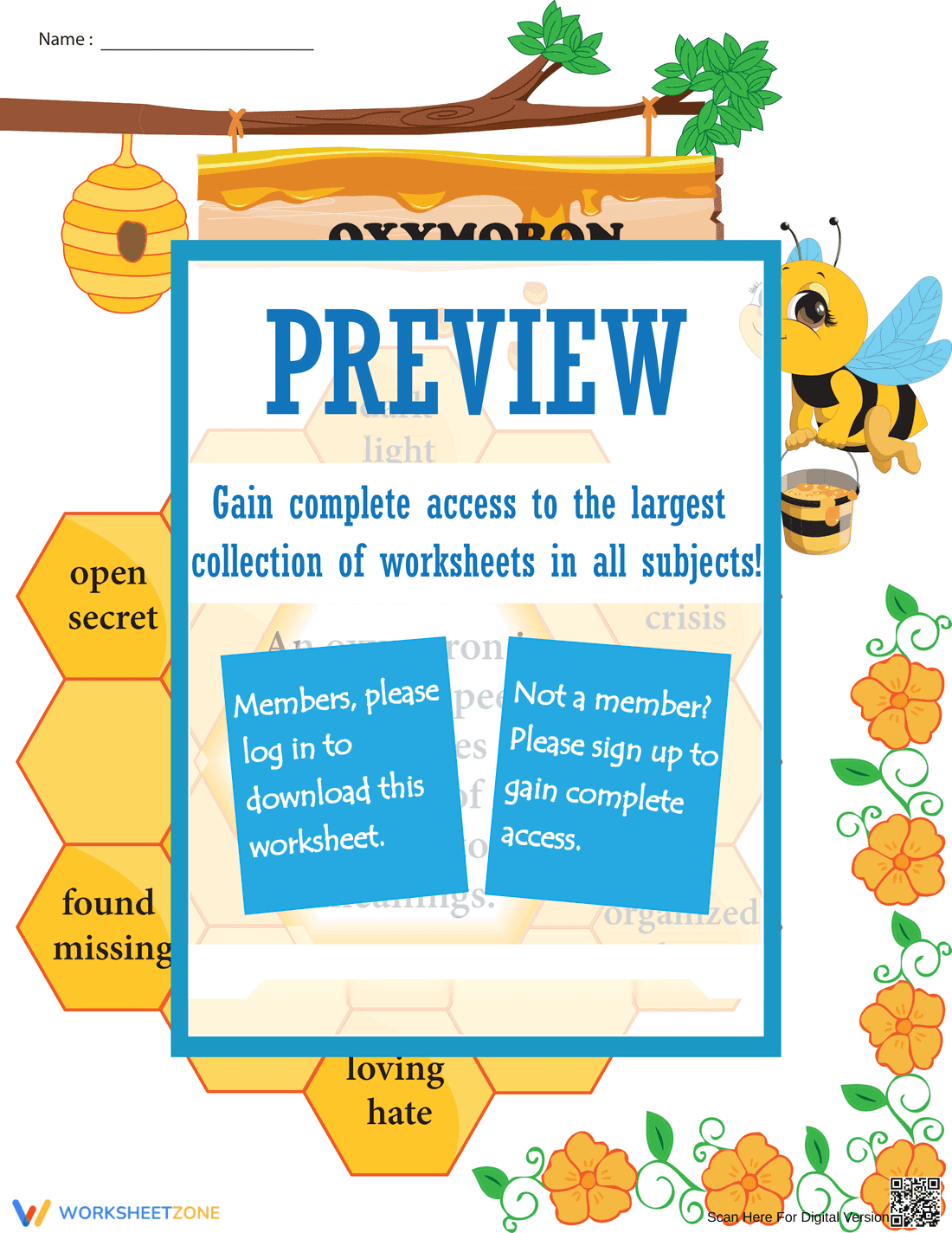
This printable oxymoron chart provides a clear and visually engaging introduction to contradictory figures of speech for elementary students. By defining what an oxymoron is and providing six relatable examples, this resource helps learners master the nuances of figurative language. It serves as an immediate reference for reading comprehension and creative writing tasks.
At a Glance
- Grade: 4 · Subject: Literature
- Standard:
CCSS.ELA-LITERACY.L.4.5— Demonstrate understanding of figurative language, word relationships, and nuances in word meanings.- Skill Focus: Oxymorons & Figurative Language
- Format: 1 page · 6 examples · Reference Chart · PDF
- Best For: Writing centers and anchor charts
- Time: 5–10 minutes
What's Inside
This single-page PDF features a vibrant honeycomb design that captures student attention immediately. The center provides a concise definition of an oxymoron as a figure of speech combining two words with contradictory meanings. Surrounding this are six carefully selected examples, including 'dark light' and 'organized chaos,' making the concept concrete for young learners who are just beginning to explore complex wordplay.
Zero-Prep Workflow
Using this resource is a smooth three-step process designed for maximum efficiency. First, print the high-resolution PDF in less than 30 seconds. Second, distribute the chart to students or display it in a prominent classroom location as a permanent anchor chart. Third, review the six examples together in under 2 minutes to verify student understanding before independent practice. This zero-prep approach is ideal for busy teachers and sub plans.
Standards Alignment
The resource is primarily aligned to CCSS.ELA-LITERACY.L.4.5, which requires students to demonstrate understanding of figurative language and word relationships. Specifically, it supports the ability to explain the meaning of figures of speech in context. This standard code can be copied directly into lesson plans, IEP goals, or district curriculum mapping tools to ensure instructional consistency across the grade level.
How to Use It
Incorporate this chart during the direct instruction phase to model how authors use contradictory terms for effect. It also functions perfectly as a formative-assessment tool; observe students as they attempt to create their own oxymorons based on the honeycomb models. Expect students to reference this chart for approximately 5-10 minutes during writing sessions or reading analysis activities to reinforce the concept.
Who It's For
This chart is designed for elementary students in Grades 1-5 who are beginning to explore complex word relationships. It is particularly beneficial for visual learners and English Language Learners (ELLs) who require concrete examples to grasp abstract linguistic concepts. Pair this resource with a short descriptive passage to help students identify oxymorons in a natural reading context while building overall literacy skills.
Mastery of figurative language, specifically oxymorons, is a critical component of the CCSS.ELA-LITERACY.L.4.5 standard, requiring students to interpret nuances in word meanings. Research from the NAEP highlights that students who can identify and explain figures of speech demonstrate significantly higher levels of reading comprehension and textual analysis. This oxymoron chart bridges the gap between basic vocabulary and sophisticated literary interpretation by providing six clear, scaffolded examples within a structured visual framework. By defining the term as a combination of contradictory meanings, the resource aligns with instructional strategies recommended by Fisher & Frey (2014) regarding the importance of explicit visual anchors in literacy development. Teachers can use this tool to build a foundation for more advanced rhetorical analysis in later grades, ensuring that students possess the essential linguistic tools to navigate complex informational and literary texts with confidence and precision.


